
Planting notes
- San Francisco’s airport averages essentially no rain in July and about 4 inches in December and January, according to NOAA normals.
- Oregon State Extension says new native plantings can take two to three years to establish before irrigation is reduced.
- California law requires 100 feet of defensible space, or to the property line, around buildings in state-responsibility and fire hazard areas.
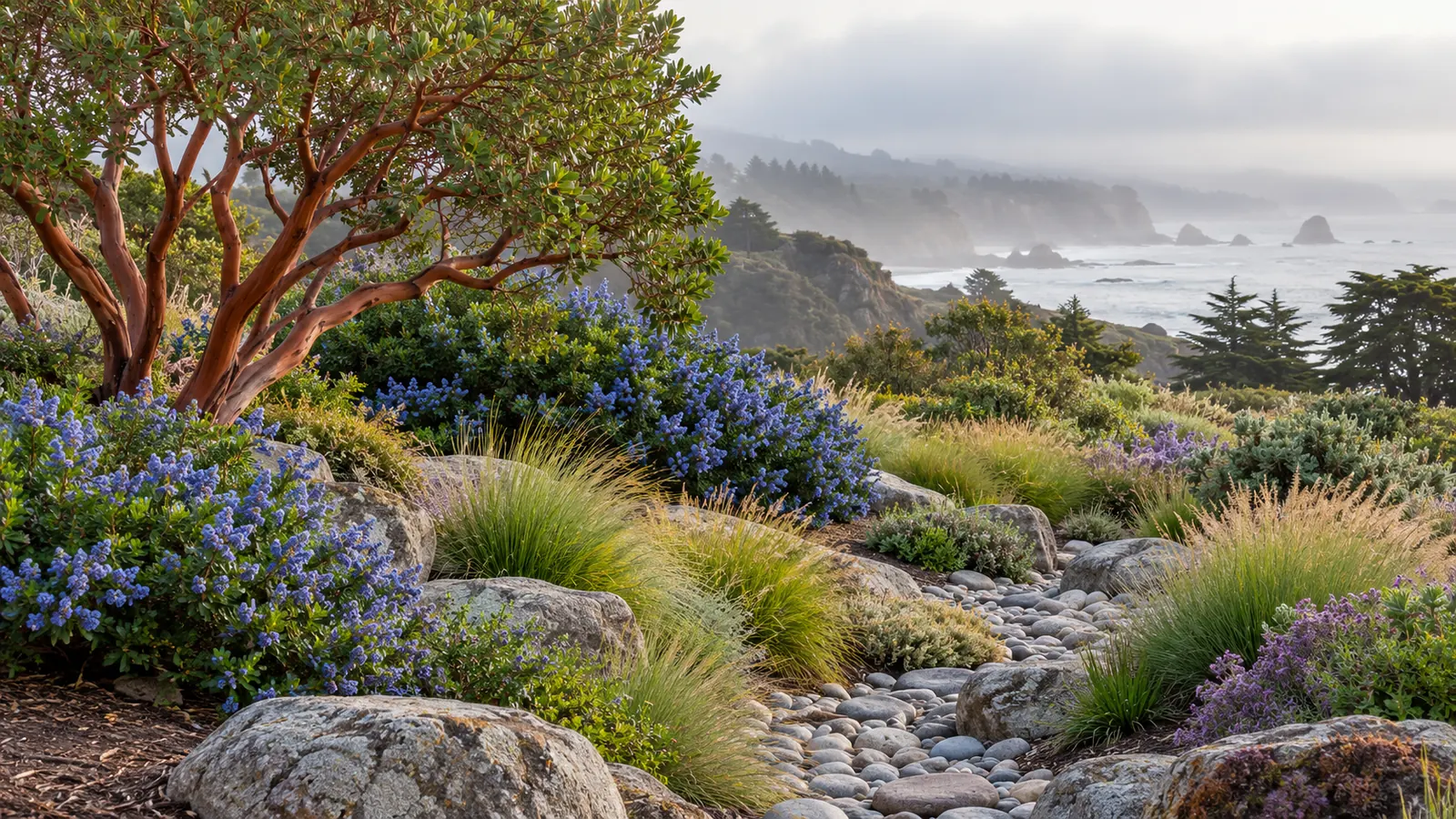
The Pacific Coast has a climate unusual in North America: mild, wet winters and long, dry summers. Gardeners elsewhere water in winter only by accident; here, summer watering is the main expense. Plants adapted to that rhythm make the best landscapes.
The climate in numbers
NOAA’s 1991-2020 normals for two coastal airports:
| Measure | Seattle-Tacoma | San Francisco |
|---|---|---|
| Annual precipitation | 39.34 inches | 19.64 inches |
| July precipitation | 0.60 inches | 0.00 inches |
| December precipitation | 5.72 inches | 4.14 inches |
| Average January low | 37.7°F | 44.5°F |
| Average July high | 77.4°F | 72.6°F |
| Days at or above 90°F | about 4 | about 4 |
The pattern is the same at both ends: most rain falls from October through April, and summers are dry.
Native plants built for summer drought
Oregon State University Extension explains that many Pacific Northwest native plants naturally tolerate the dry summers of the near-Mediterranean climate west of the Cascades, from woodlands, savannahs, meadows and seasonal wetlands. Its advice:
- Group drought-tolerant plants together, a practice it calls zoning, and pay attention to sun, shade and drainage.
- Water new plantings enough to build healthy roots; establishment can take two to three years. Then reduce extra irrigation gradually, watching for wilting, curling or dull leaves.
- Some natives prefer little or no summer water. The Oregon white oak is subject to root rot if irrigated, and camas bulbs need dry summers so they do not rot.
- Some natives, such as wild bleeding heart and lady fern, die back naturally in dry summer months.
- Look to neighboring ecosystems for more drought-tolerant plants, such as golden currant from east of the Cascades or California fuchsia from California.
Plants from year-round wet places, some streamside areas and moist mountain woodlands are not drought tolerant and need more water.
Tip: Do not water summer-dry natives like a lawn. For plants such as Oregon white oak, summer irrigation can cause the root rot that drought never would.
Time planting with the rain
Because almost all the rain falls between October and April, the wet season does much of the establishment watering for you. Seattle’s normals show 6.31 inches in November and 5.78 in January, against 0.60 in July. Planting as the rains return, then watering through the first dry summers as Oregon State advises, gives roots the longest possible start. EPA WaterSense notes that residential outdoor water use across the United States accounts for nearly 8 billion gallons a day, mainly for landscape irrigation; on the coast, that use is concentrated in the dry months, which is exactly where summer-dry plants save the most.
Wildfire and defensible space
Much of the coast, especially in California, has wildfire risk in grass, brush and forest. Fire Safe San Mateo summarizes California’s rules:
- Public Resources Code 4291 requires 100 feet of defensible space, or to the property line, around buildings in the State Responsibility Area and designated fire hazard zones.
- Assembly Bill 3074 added a third zone: Zone 0, an ember-resistant zone within 5 feet of structures.
| Zone | Distance | What to do |
|---|---|---|
| Zone 0, ember-resistant | 0 to 5 feet | Nothing combustible, including under decks; gravel, pavers or bare soil; no bark or wood mulch; clear leaves; noncombustible last 5 feet of any attached wood fence |
| Zone 1, lean, clean and green | 5 to 30 feet | Fuels low, watered, separated and free of dead material; separate shrubs, trees and combustible items |
| Zone 2, reduced fuel | 30 to 100 feet | Horizontal spacing based on slope and plant height; vertical spacing to remove fire ladders |
The group notes that fire burns faster uphill, so steep sites need more space. For vertical clearance between a shrub and tree branches above it, it suggests multiplying the shrub’s height by three. It also warns that embers can travel a mile or more ahead of a fire, so the house itself must resist ignition as well.
Water-wise design
EPA WaterSense recommendations fit the coast well: hydrozones, turf only where it is used, mulch three to four inches deep and deep-rooted plants on slopes. Wet winters make rain gardens and swales useful for catching runoff, and summer-dry natives can sit on the rim of a rain garden where water drains away quickly.
A sample plan
| Area | Ideas |
|---|---|
| 0 to 5 feet | Gravel band, no wood mulch, no shrubs against the house |
| Front yard | Summer-dry native shrubs and bunchgrasses, small or no lawn |
| Dry creek bed | Carries winter runoff, decorative in summer |
| Shade | Native or summer-dry tree, away from the house in fire areas |
| Vegetable bed | Separate, irrigated hydrozone near the kitchen |
The bottom line
Plant for wet winters and dry summers: natives and Mediterranean-climate plants, grouped by water need, watered while they establish and then mostly left alone. In fire country, follow the zones, starting with the first five feet. For the inland mountains, see Landscaping in the Mountain West: Short Seasons and Wildfire Zones.