
Planting notes
- Measured annual cooling savings from landscape shading average between 10 and 50 percent across studies, according to Building America.
- Two identical Alabama houses showed a 59 percent reduction in July cooling for the one in full shade.
- Kansas State says actual fuel savings from windbreak protection can range from 15 to 25 percent.
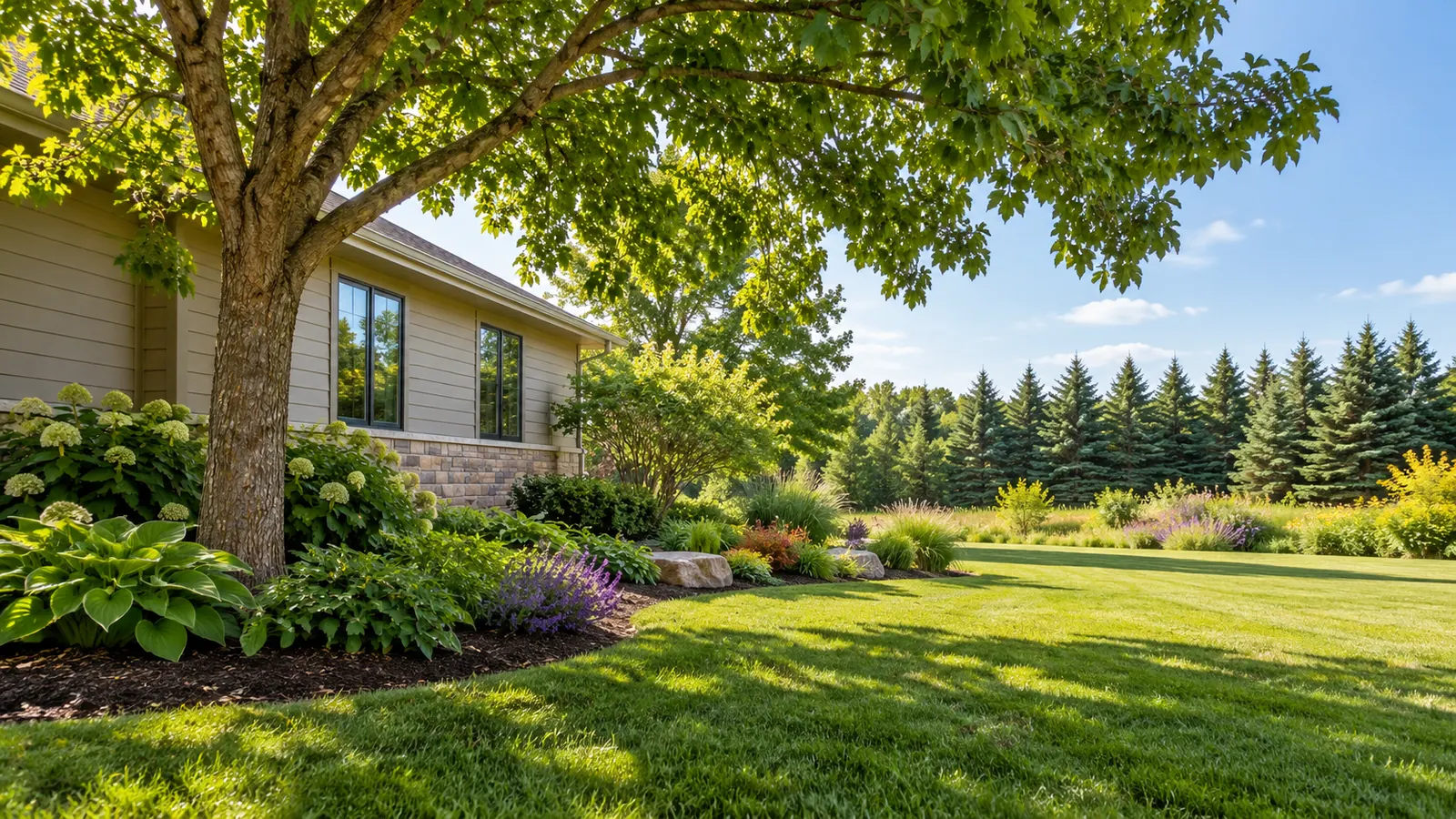
Landscaping is one of the few home improvements that grows more valuable each year. A shade tree planted in the right spot lowers summer cooling costs for decades, and a well-placed windbreak can cut heating costs on a windy winter site. The key is placement.
What the research shows
Building America, a Department of Energy research program run by Pacific Northwest National Laboratory, summarizes several studies on landscaping and cooling:
| Finding | Study |
|---|---|
| 10% to 50% | Measured potential annual cooling savings from landscape shading, averaged across studies |
| 59% | Reduction in July cooling for a fully shaded house versus an identical house in full sun, Alabama |
| 30% | Cooling energy savings from relocating large trees, two houses in Sacramento |
| About 2% | Cooling reduction from shading an air conditioner’s outdoor unit without blocking airflow, Florida |
| 1 to 5 degrees | How much cooler heavily landscaped neighborhoods were on hot summer afternoons |
Plants cool in two ways: shade, and transpiration, the evaporation of water through leaves. Building America notes that a large tree can transpire up to 100 gallons of water a day when soil moisture and air conditions allow.
Shade the right sides first
Building America explains the sun’s path: in midsummer the east and west walls and windows get the most solar heat; in early and late summer the south side gets about as much as east and west; in fall, winter and spring the south side gets the most. Its advice:
- Shade east and west walls and windows first.
- Shade the south side next, with deciduous trees that drop their leaves and let winter sun in.
- Use tall trees with high canopies for south-facing windows and to shade the roof.
- Use shrubs close to the house for low-angle morning and evening sun on east and west walls.
- Shade driveways, patios and other paving. Building America notes roofs and pavement in the sun can reach 50 to 90 degrees Fahrenheit above air temperature.
Tip: Shade the air conditioner’s outdoor unit, but do not crowd it. Building America cites a Florida study that found about a 2 percent cooling reduction from plants shading the condenser without blocking airflow.
Block winter wind
Building America notes that rows of shrubs and trees reduce the wind flowing past a house, and that this effect matters more in winter than in summer. It recommends evergreens on the north side to cut cold winter air leakage without blocking winter sun.
On open sites, especially on the Plains, a full windbreak does much more. Kansas State Research and Extension says calm air insulates better than moving air, so heat loss through walls, roofs and windows drops, and that actual fuel savings from windbreak protection can range from 15 to 25 percent. Its guidance:
- Place windbreaks on the north and west sides, against the prevailing winter wind.
- Good protection extends downwind about 10 times the height of the trees: a 30-foot windbreak protects about 300 feet.
- Make the windbreak extend at least 100 feet beyond the area you want to protect, because wind eddies form around the ends; any gaps funnel the wind.
- Use multiple rows, with evergreens for winter density.
Purdue Extension recommends at least two rows of conifers plus rows of tall deciduous trees and shrubs, placed 2 to 5 times the windbreak’s height from the area to be protected, perpendicular to the prevailing winter wind. More on the Plains in Landscaping on the Great Plains: Wind, Drought and Windbreaks.
Match the strategy to your climate
| Climate | Priority |
|---|---|
| Hot and humid (Southeast, Gulf Coast) | Maximum summer shade on east, west and roof; keep breezes flowing |
| Hot and dry (Desert Southwest) | Shade walls, windows and paving; choose low-water trees |
| Cold and windy (Plains, northern Midwest, mountains) | Windbreaks on north and west; deciduous trees on south to keep winter sun |
| Mixed (Northeast, Mid-Atlantic) | Deciduous shade on east, west and south; evergreens on the north |
In wildfire country, keep trees and shrubs well away from the house; see Landscaping in the Mountain West: Short Seasons and Wildfire Zones and Landscaping on the Pacific Coast: Dry Summers and Defensible Space.
Plant for the long term
Building America recommends consulting a local arborist when preserving trees during construction: protect roots out to the edge of the canopy, avoid compacting soil and do not change the soil depth around trunks. For new plantings, it repeats the slogan “right plant, right place”: suited to your climate, soil and drainage, and to its mature size. In hurricane-prone areas, consider how high winds will affect the trees you keep or plant.
The bottom line
Shade east and west first, then south with deciduous trees; block winter wind on the north and west; shade paving and the air conditioner. The savings measured in studies range widely, but they grow every year the trees do. For siting trees in your overall design, see How to Draw a Landscape Plan for Your Yard, Step by Step.