
Planting notes
- Denver averages 14.48 inches of precipitation a year and a median last spring freeze around May 5, according to NOAA’s 1991-2020 normals.
- Colorado State University Extension divides defensible space into zone 1 (0 to 5 feet), zone 2 (5 to 30 feet) and zone 3 (30 to 100 feet).
- CSU recommends only plants rated 8 to 10 on its 0-to-10 flammability scale for the two zones nearest the house.
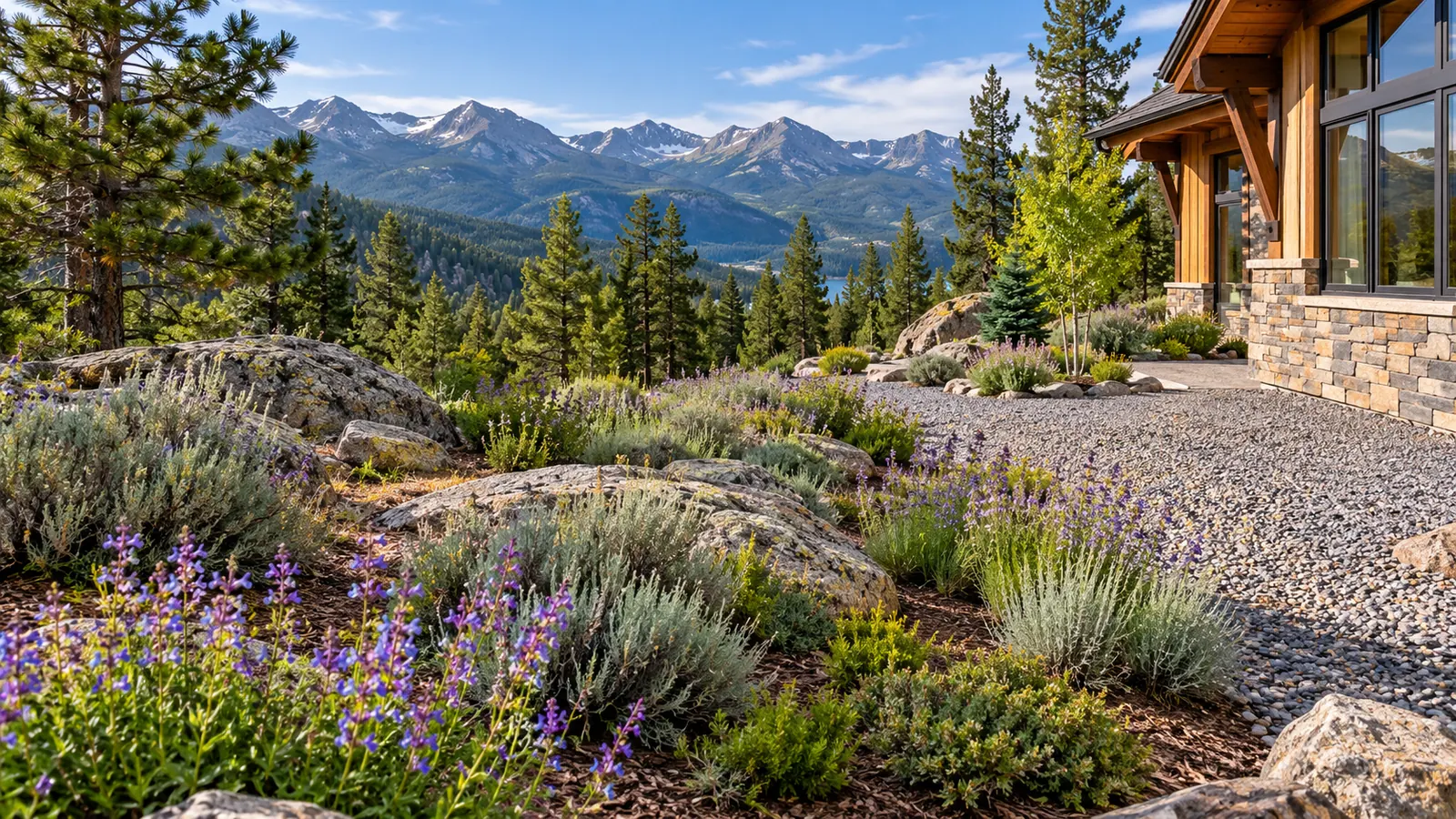
The Mountain West offers sunshine, views and dramatic seasons, along with a short growing season, low humidity and, in forested and grassy areas, a real wildfire risk. A good mountain landscape is drought-wise and fire-wise at the same time.
The climate in numbers
NOAA’s 1991-2020 normals for Denver International Airport, on the plains edge of the Front Range:
| Measure | Denver (NOAA normals) |
|---|---|
| Annual precipitation | 14.48 inches |
| Average January low | 18.7°F |
| Average July high | 89.9°F |
| Nights at or below freezing | about 156 a year |
| Median last spring freeze | around May 5 |
| Median first fall freeze | around October 9 |
| Typical freeze-free season | about 156 days |
Most precipitation falls from April through August, with around 2 inches in each of May and July; winters are dry, at about 0.4 inches a month. Higher in the mountains, seasons are shorter still and snow lasts longer.
Short season, tough plants
With a frost-free season of around five months, choose perennials, shrubs and trees rated for your USDA hardiness zone and test them against local experience. USDA notes that microclimates matter: a south-facing slope may be much warmer than a shaded hollow, and frost pockets form in valleys. Mountain sites also see strong sun and wind that dry out plants in winter; USDA lists winter sunshine and dry autumn soil among the factors that can injure plants even within their hardiness zone. See Find Your Hardiness Zone and What It Really Tells You.
Wildfire: think in zones
Colorado State University Extension and the Colorado State Forest Service describe defensible space as the area around a home managed to reduce wildfire risk, by increasing horizontal and vertical space between plants and reducing plant volume. They divide it into three zones:
| Zone | Distance from the house | Goal |
|---|---|---|
| Zone 1 | 0 to 5 feet | Nearest the house; only the least flammable plants, if any |
| Zone 2 | 5 to 30 feet | Low-flammability plants with space between them |
| Zone 3 | 30 to 100 feet | Covered in CSU’s fire-resistant landscaping fact sheet |
Low-flammability plants
CSU’s low-flammability plant guide, built on a method developed by Idaho Firewise, rates plants from 0, most flammable, to 10, least flammable. For zones 1 and 2, nearest the house, it recommends only plants rated 8, 9 or 10. CSU stresses that maintenance is ongoing: keeping plants hydrated is key to keeping them less flammable, and native plants tend to stay hydrated with less water.
Tip: No plant is fireproof. Spacing, maintenance and the first five feet around the house matter more than any single plant choice.
The first five feet
Fire agencies stress that the area right next to the house matters most, because wind-driven embers collect there. Fire Safe San Mateo in California, describing that state’s ember-resistant zone, recommends hardscape or noncombustible ground cover such as gravel, pavers or bare soil, no bark or wood mulch, clearing leaves and debris, and replacing the last 5 feet of any wood fence that attaches to the house with a noncombustible section. The same logic applies in Colorado’s zone 1. See Landscaping on the Pacific Coast: Dry Summers and Defensible Space for California’s legal requirements.
Slopes and ladder fuels
Many mountain homes sit on slopes, and fire moves faster and burns hotter uphill. Fire Safe San Mateo advises that homes on steep or windswept sites need more space between plants than the minimums, and that vertical spacing matters as much as horizontal: grass, shrubs and tree canopies should not form a ladder that carries fire upward. Its rule of thumb for clearance between a shrub and the lowest tree branches above it is three times the shrub’s height. Remove fallen needles, leaves and small branches; a layer up to 3 inches deep may stay where it is needed to control erosion.
Water in a semi-arid climate
With about 14.5 inches of precipitation a year, irrigation matters. EPA WaterSense recommends:
- Grouping plants by water need in hydrozones, with turf separate from shrubs.
- Soil tests and soil amendments to help the soil hold water.
- Mulch three to four inches deep, kept a few inches from trunks. In wildfire zones, use gravel or rock near the house instead of wood mulch.
- Deep-rooted native ground covers and shrubs on slopes to prevent erosion.
Soil
Mountain and foothill soils vary widely, from rocky and thin to heavy clay. Test before planting and amend beds with compost where needed; see Test Your Soil Before You Plant: A Homeowner’s Guide. Do not rely on heavy fertilizing: native and drought-tolerant plants generally need little.
A sample plan for a foothills home
| Area | Ideas |
|---|---|
| 0 to 5 feet | Gravel or pavers, no wood mulch, no shrubs touching the house |
| 5 to 30 feet | Spaced low-flammability perennials and low shrubs, irrigated |
| 30 to 100 feet | Thinned native vegetation, trees limbed up, dead material removed |
| Sunny south slope | Drought-tolerant natives, rock garden |
| Driveway | Clear of overhanging branches for fire trucks |
The bottom line
Pick plants for a short, dry season, water in hydrozones, and plan the space around the house in fire zones with low-flammability plants and a clear first five feet. For the Plains to the east, see Landscaping on the Great Plains: Wind, Drought and Windbreaks.