
Planting notes
- Kansas State says actual fuel savings from windbreak protection can range from 15 to 25 percent.
- Good wind protection extends about 10 times the windbreak’s height downwind, so a 30-foot windbreak protects about 300 feet.
- Wichita averages 34.3 inches of precipitation a year and about 65 days at or above 90 degrees, according to NOAA normals.
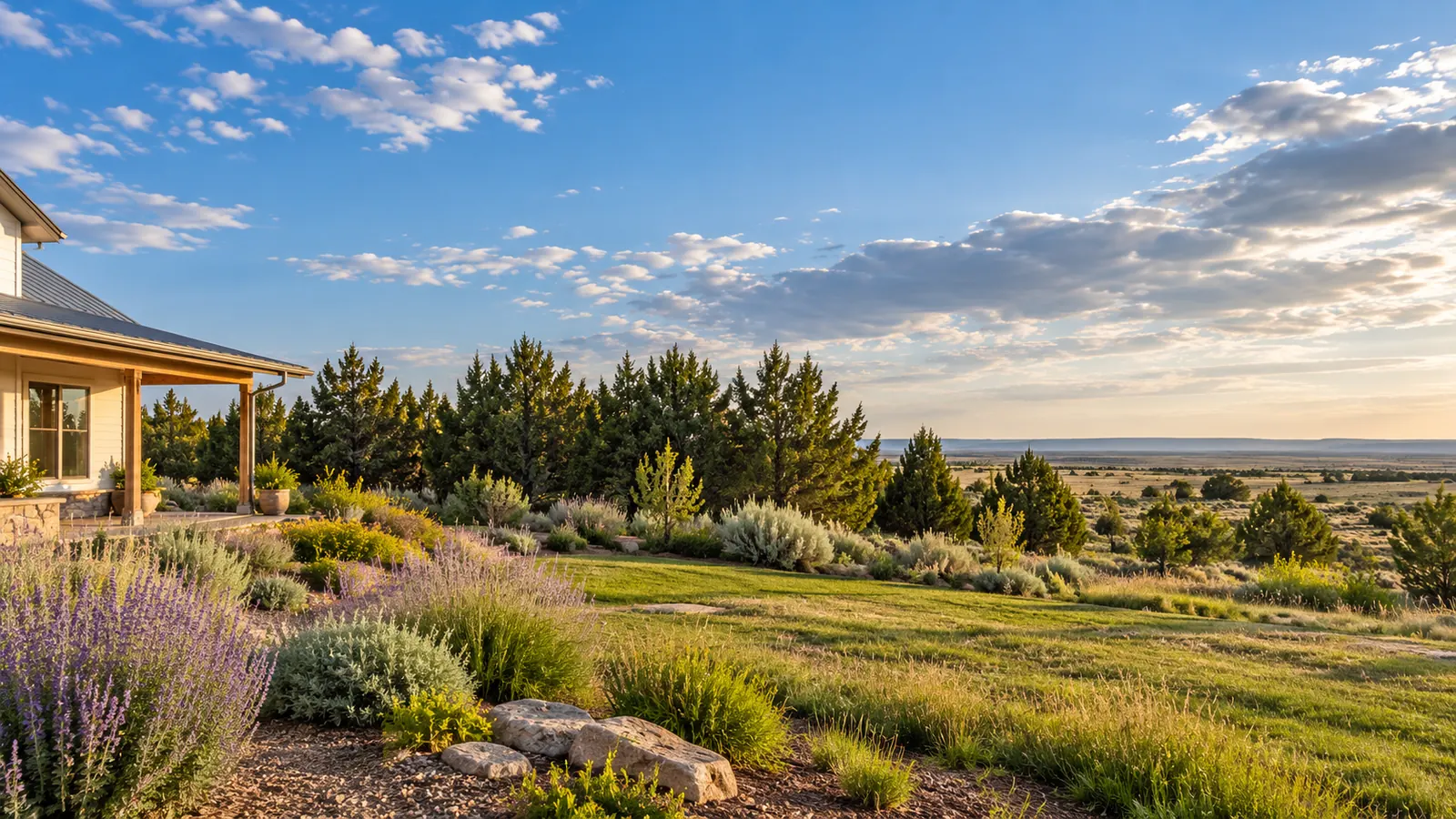
Big skies come with big wind. On the Great Plains, a yard without shelter is cold in winter, hot and dusty in summer and hard on anything newly planted. That is why the central idea of a Plains landscape is not a flower bed but a windbreak.
The climate in numbers
NOAA’s 1991-2020 normals for Wichita, Kansas:
| Measure | Wichita (NOAA normals) |
|---|---|
| Annual precipitation | 34.31 inches |
| Annual snowfall | 12.7 inches |
| Average January low | 22.5°F |
| Average July high | 92.6°F |
| Days at or above 90°F | about 65 a year |
| Median last spring freeze | around April 11 |
| Median first fall freeze | around October 29 |
| Typical freeze-free season | about 199 days |
Precipitation is heavily seasonal: about 0.85 inches in January but 5.17 in May and 4.93 in June. Winters are dry; late spring and early summer bring most of the year’s rain, often in storms.
Why a windbreak comes first
Kansas State Research and Extension lists what windbreaks do around a home: reduce heating costs, reduce wind chill, control drifting snow, protect gardens and ornamentals and provide food and cover for wildlife. It explains that calm air insulates better than moving air, so heat loss through walls, roofs and windows drops, and that actual fuel savings from windbreak protection can range from 15 to 25 percent.
Designing a home windbreak
| Guideline | Kansas State and Purdue Extension |
|---|---|
| Where | North and west sides of the area to protect, against prevailing winter wind |
| How far it protects | Good protection about 10 times the trees’ height downwind; some effect out to about 30 times |
| Length | At least 100 feet beyond the protected area on each end, because wind eddies around the ends |
| Gaps | Avoid them; gaps funnel wind. Route driveways around the ends |
| Rows (K-State) | Five rows are effective; three to four if space is limited; at least two rows of evergreens |
| Rows (Purdue) | At least two rows of conifers plus rows of tall deciduous trees, tall shrubs and short shrubs |
| Distance (Purdue) | 2 to 5 times the windbreak’s height from the area to protect |
| Roads (K-State) | Not closer than 200 feet north or west, or 80 feet south or east, of a road’s centerline, to avoid drifts on the road |
K-State suggests that the north and west rows be dense shrubs or evergreens, with evergreens in the second and third rows and faster-growing deciduous trees or shrubs in additional rows. A 30-foot-tall windbreak, its guide notes, can give good protection about 300 feet downwind.
Tip: Sketch before you plant. K-State recommends drawing the area to protect, including buildings, roads, gardens, utilities above and below ground, and the direction of winter wind, then fitting the windbreak around it.
Managing snow
A windbreak traps snow, which is good when the snow lands in the right place. K-State explains that the area just downwind of a windbreak collects the most snow. To keep drifts out of the protected yard, it suggests placing the main windbreak about 3 times its height from the area and planting a single row 100 to 150 feet farther to windward as a snow trap. Keep drives and walkways out of the drift zone.
Summer protection
Plains summers are hot and windy. K-State notes that summer windbreaks usually consist of one or two rows located south of the area to be protected, often deciduous shrubs or small trees in front of taller deciduous trees; they slow hot wind but still allow a breeze, and windbreaks also trap blowing dust. Deciduous shade trees on the south and west, placed so they do not block the cooling breeze, make outdoor living possible in July. See Landscaping for Energy Savings: Shade Trees and Windbreaks.
Plants that cope
- Native grasses and prairie perennials, which evolved with drought and wind and need little water once established; see Landscaping in the Midwest: Prairie Plants, Rain Gardens and Cold Winters for prairie plants and planting tips.
- Evergreens adapted to your county for windbreak rows; ask the local extension office or state forest service which species they recommend.
- Low-water turf only where it is used. EPA WaterSense recommends choosing a turfgrass suited to your climate and keeping it in its own hydrozone.
Water wisely
With dry winters and hot summers, establishment watering matters. EPA WaterSense notes that trees and shrubs need irrigation while they establish, and that a small berm around each plant holds water at the roots. After that, deep, occasional watering beats frequent sprinkling. Mulch three to four inches deep, EPA suggests, to cut evaporation and keep roots cooler.
Diversity for health
K-State recommends diversity in a windbreak planting to increase insect and disease resistance and wildlife habitat. Within a single row, though, it advises not mixing plant varieties, because one usually grows faster and eventually suppresses the slower ones; the exception is shrubs with comparable growth rates and form, mixed for wildlife.
A sample plan
| Area | Ideas |
|---|---|
| North and west | Multi-row windbreak: shrubs outside, evergreens inside, deciduous trees beyond |
| Windward of the windbreak | Single-row snow trap 100 to 150 feet out |
| South side | Deciduous shade trees for summer, open for winter sun |
| Yard | Small lawn near the house; native grass and wildflower areas beyond |
| Garden | Inside the protected zone, out of the drift area |
The bottom line
Start with the windbreak, on the north and west, long enough and dense enough to do its job, then plant the rest of the yard inside its shelter. It pays back in lower heating bills, controlled snow and a yard you can actually use. For the dry mountains to the west, see Landscaping in the Mountain West: Short Seasons and Wildfire Zones.