
Planting notes
- Boston averages about 43.6 inches of precipitation and 49.2 inches of snow a year, with a median last spring freeze around April 4, according to NOAA’s 1991-2020 normals.
- UConn Extension recommends fences at least 8 feet tall to keep deer out, and placing the most deer-resistant plants along the property’s outer edge.
- UMass Extension says no plant will resist deer feeding under all conditions.
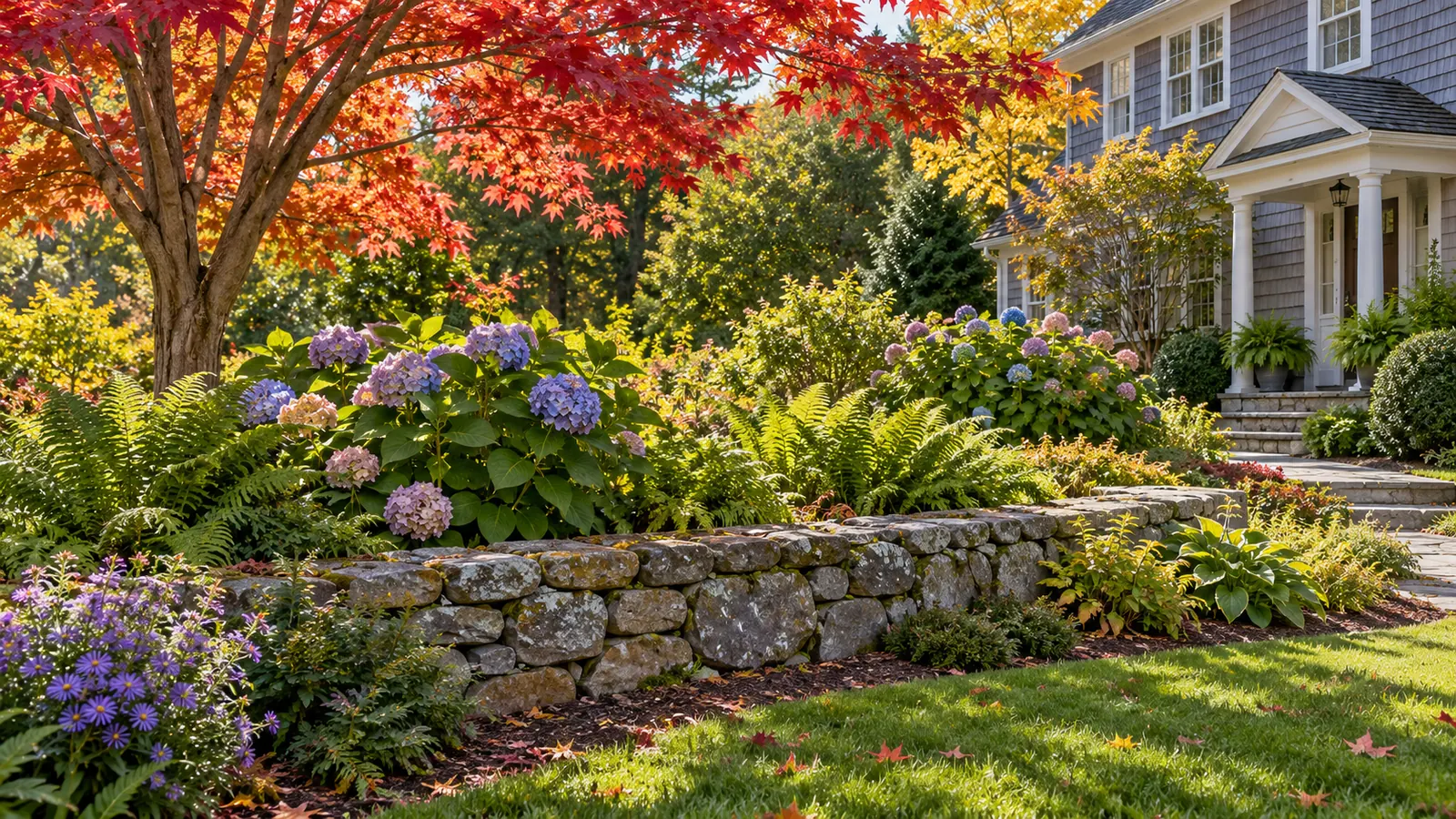
The Northeast rewards a landscape with structure: stone walls, evergreens, a few strong trees, and beds that look good in snow as well as in June. It also tests one, with cold winters, heavy snow, humid summers and some of the hungriest deer in the country.
The climate in numbers
NOAA’s 1991-2020 climate normals for Boston’s Logan Airport give a sense of the coastal Northeast:
| Measure | Boston (NOAA normals) |
|---|---|
| Annual precipitation | 43.59 inches, spread fairly evenly across the year |
| Annual snowfall | 49.2 inches |
| Average January low | 23.1°F |
| Average July high | 82.1°F |
| Days at or above 90°F | about 14 a year |
| Median last spring freeze (32°F) | around April 4 |
| Median first fall freeze | around November 9 |
| Typical freeze-free season | about 218 days |
Inland and at higher elevations, winters are colder and the season shorter. Check your own ZIP code on the USDA hardiness map; see Find Your Hardiness Zone and What It Really Tells You.
Rain is steady, so plan for drainage
Boston’s monthly normals hover between about 3.2 and 4.3 inches every month of the year. Water is rarely the limit; drainage and runoff are. EPA’s Soak Up the Rain program promotes rain gardens, shallow planted areas that catch water from roofs and driveways and let it soak in, and several Northeastern states publish homeowner guides to building them. A rain garden near a downspout handles the spring thaw and summer thunderstorms and can be planted with native perennials and grasses. EPA warns to check where underground utilities run before you dig.
EPA’s WaterSense program features a Northeastern yard where the owners replaced turf with a granite walkway and native drought-tolerant grasses; once established, it needs no water beyond normal rainfall.
Deer are the design problem
Extension services across New England put deer high on the list. UMass Extension notes that browsing damage tends to rise along with deer populations in rural and suburban areas, and that no plant will resist deer feeding under all conditions; hungry deer in late winter and early spring will eat young trees and shrubs with little discrimination. UConn Extension’s advice for the home landscape:
- Use plants deer prefer not to eat, and accept that “deer resistant” is not “deer proof.”
- Divide the landscape into zones: the most deer-resistant plants along the outer edge of the property, the most tempting ones close to busy entrances.
- Fence where possible; deer jump, so fences need to be at least 8 feet tall.
- Protect young trees and shrubs with wire-mesh cylinders against feeding and antler rubbing.
- Use less fertilizer where deer visit often; they favor lush, well-fertilized plants.
UMass suggests sturdy wire-mesh barriers on newly planted woody plants, left in place until they are established if deer pressure is heavy.
Tip: Some plants deer leave alone are invasive. UConn notes that Oriental bittersweet and Japanese barberry spread into forests and push out native plants. Choose natives instead.
Plan for snow and salt
- Leave room along driveways and walks for plowed and shoveled snow; do not plant shrubs where the pile goes.
- Keep salt-sensitive plants back from the street and the driveway edge.
- Choose shrubs with flexible branches near roof edges where snow slides off, or keep beds out of the drip line.
- Use evergreens on the north and west to cut winter wind; Building America research recommends evergreens on the north side to reduce cold air leaking into a house without blocking winter sun.
Four-season structure
A Northeastern plan works best with something to look at in every season: spring bulbs and flowering trees, summer perennials, autumn color from maples and native shrubs, and winter structure from evergreens, bark, seed heads and stone. Stone walls and gravel paths are part of the regional style and need no water.
Soil and mulch
Test the soil before planting; see Test Your Soil Before You Plant: A Homeowner’s Guide. Penn State Extension, serving the Mid-Atlantic edge of the region, recommends testing sandy soils every 2 to 3 years and clay soils every 3 to 4. Mulch beds three to four inches deep, EPA suggests, keeping it a few inches from trunks.
A sample plan for a suburban lot
| Area | Ideas |
|---|---|
| Street edge | Salt-tolerant, deer-resistant native shrubs and grasses |
| Front walk | Stone or brick path, low perennials, spring bulbs |
| Foundation | Mix of evergreen and deciduous shrubs, kept a few feet off the house |
| Downspout | Rain garden with native perennials |
| Back lawn | A modest lawn for play, separate from the shrub zone |
| North and west lines | Evergreen screen for wind and privacy |
| Vegetable bed | Fenced against deer, near the kitchen door |
The bottom line
Plan for steady rain with good drainage, for snow with space and tough plants, and for deer with zoning, fencing and the right plant choices. Native plants and stone fit the region and the climate. For the bigger planning steps, see How to Draw a Landscape Plan for Your Yard, Step by Step.