
Planting notes
- Florida law defines Florida-friendly landscaping by nine principles, starting with “the right plant in the right place.”
- Miami averages about 67.4 inches of rain a year, more than 10 inches each in June and September, according to NOAA normals.
- UF/IFAS says Florida-Friendly Landscaping does not promote all-rock yards, artificial turf or rubber mulch.
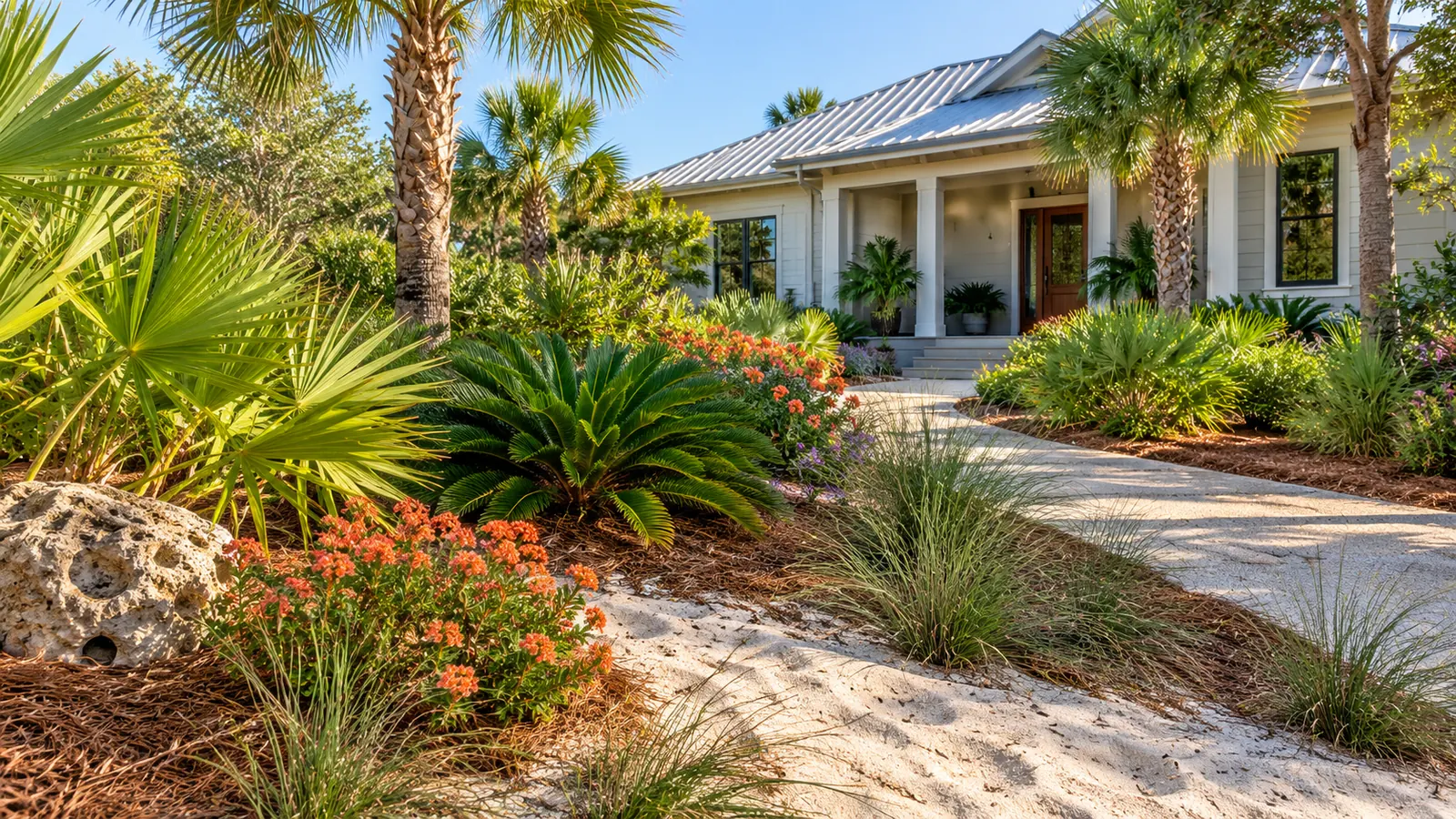
From Houston to Miami, landscapes face a climate unlike the rest of the continental United States: hot nearly all year, wet summers, sandy or poorly drained soils and the threat of hurricanes. Florida has gone furthest in putting good landscaping practice into law, and its principles work across the Gulf Coast.
The climate in numbers
NOAA’s 1991-2020 normals for two Gulf airports:
| Measure | Miami | Houston (Intercontinental) |
|---|---|---|
| Annual precipitation | 67.41 inches | 51.84 inches |
| Average January low | 61.0°F | 43.7°F |
| Average July high | 90.6°F | 94.5°F |
| Days at or above 90°F | about 91 | about 111 |
| Freezing nights a year | 0 | about 10 |
Miami’s rain is seasonal: under 2.5 inches a month from December through March, but 10.51 inches in June and 10.22 in September. Plants must handle both a dry winter and soaked summer soil.
Florida-Friendly Landscaping in law
Florida Statutes section 373.185 defines “Florida-friendly landscaping” as quality landscapes that conserve water, protect the environment, are adaptable to local conditions and are drought tolerant. The law lists its principles:
- Planting the right plant in the right place.
- Efficient watering.
- Appropriate fertilization.
- Mulching.
- Attracting wildlife.
- Responsible management of yard pests.
- Recycling yard waste.
- Reducing stormwater runoff.
- Waterfront protection.
The same statute directs Florida’s water management districts to encourage local governments to adopt Florida-friendly landscaping ordinances, which can identify prohibited invasive plants, limit the share of irrigated turf and pavement, and protect existing native vegetation. The University of Florida’s IFAS Extension runs the Florida-Friendly Landscaping program that explains the principles to homeowners.
What HOAs can and cannot do
UF/IFAS has published questions and answers on the state’s Florida-friendly law and homeowners’ associations. Key points:
- The law did not change HOA approval processes. If your covenants require approval for landscape changes, you still need it.
- A Florida-Friendly landscape can include both native and non-native plants and turfgrass, as long as they suit the site.
- An HOA may restrict landscapes made only of rocks and gravel, artificial turf or mulch, which the program does not promote, and may set reasonable rules for rain barrels, compost bins and specialty gardens.
UF/IFAS adds that all-rock yards, artificial turf and rubber mulch increase heat and can lose wildlife habitat. Rocks can still be useful in moderation, for example where roof runoff falls, since woody mulch along a foundation may attract termites.
Tip: Before you rip out a lawn in an HOA community, submit a plan. Show which principles it follows; UF/IFAS provides materials designed for architectural review boards.
Right plant, right place, in practice
- Match each plant to the light, soil moisture and salt exposure of its spot. Coastal yards need salt-tolerant plants on the windward side.
- Put moisture-loving plants in low areas that stay wet in summer, and drought-tolerant ones on sandy high ground.
- Keep turf where it is used; WaterSense recommends low-water turfgrass suited to your climate and separate hydrozones for turf and shrubs.
- Mulch beds; EPA suggests three to four inches, kept a few inches from trunks.
Easements, setbacks and vegetable gardens
UF/IFAS says homeowners may make easements and setbacks they maintain Florida-Friendly, as long as the change does not interfere with the easement’s purpose: no shrubs or trees in a travel or utility easement, but a drought-tolerant ground cover or turf that avoids watering a hard-to-irrigate strip may be reasonable. Florida law also bars counties and cities from regulating vegetable gardens on residential property, with exceptions for general rules on water use during drought, fertilizer use or control of invasive species; HOA covenants are a separate matter.
Hurricanes and trees
Building America guidance from the Department of Energy notes that in hurricane-prone areas you should consider how high winds will affect the trees you keep or plant, and that trees left on the edge of a cleared forest have adapted to wind while interior trees may not have. Consult a local arborist about wind-firm species and placement, and keep large trees a safe distance from the house. Shade trees still matter: in this climate, shading the east and west walls, the roof and paving saves energy most of the year; see Landscaping for Energy Savings: Shade Trees and Windbreaks.
Stormwater
Reducing runoff is one of the nine principles. Rain gardens, swales, permeable paths and mulched beds let summer downpours soak in instead of rushing to the street. Direct downspouts into planted areas rather than onto pavement.
A sample plan for a Gulf Coast lot
| Area | Ideas |
|---|---|
| Front yard | Smaller lawn area, mulched beds of drought-tolerant natives and adapted plants |
| West wall | Wind-firm shade tree at a safe distance |
| Low corner | Rain garden with moisture-tolerant plants |
| Foundation | Rock band under roof drip line, shrubs beyond it |
| Back patio | Shade structure, permeable pavers |
The bottom line
Use the nine Florida-Friendly principles as a checklist, plant for both dry winters and soaked summers, keep turf modest and purposeful, plan trees for hurricanes and work with your HOA. For the rest of the Southeast, see Landscaping in the Southeast: Heat, Humidity and Acid Soil.